Skip to content

1. Introduction
The Nile. With nearly 6,700 kilometers long, it is one of the longest rivers in the world. It crosses 11 countries, covering more than 35° of latitude and draining an area of more than 3 million square kilometers – one tenth of the total landmass of Africa. From the Great Lakes of East Africa and the Ethiopian highlands to the Mediterranean Sea, its waters are home to hundreds of millions of people, shaping entire civilizations for millennia. Driven by population explosion, food and water scarcity, and climate change, the Nile basin has entered a new era of challenges and opportunities, in which Egypt, Sudan, and Ethiopia play a central role.
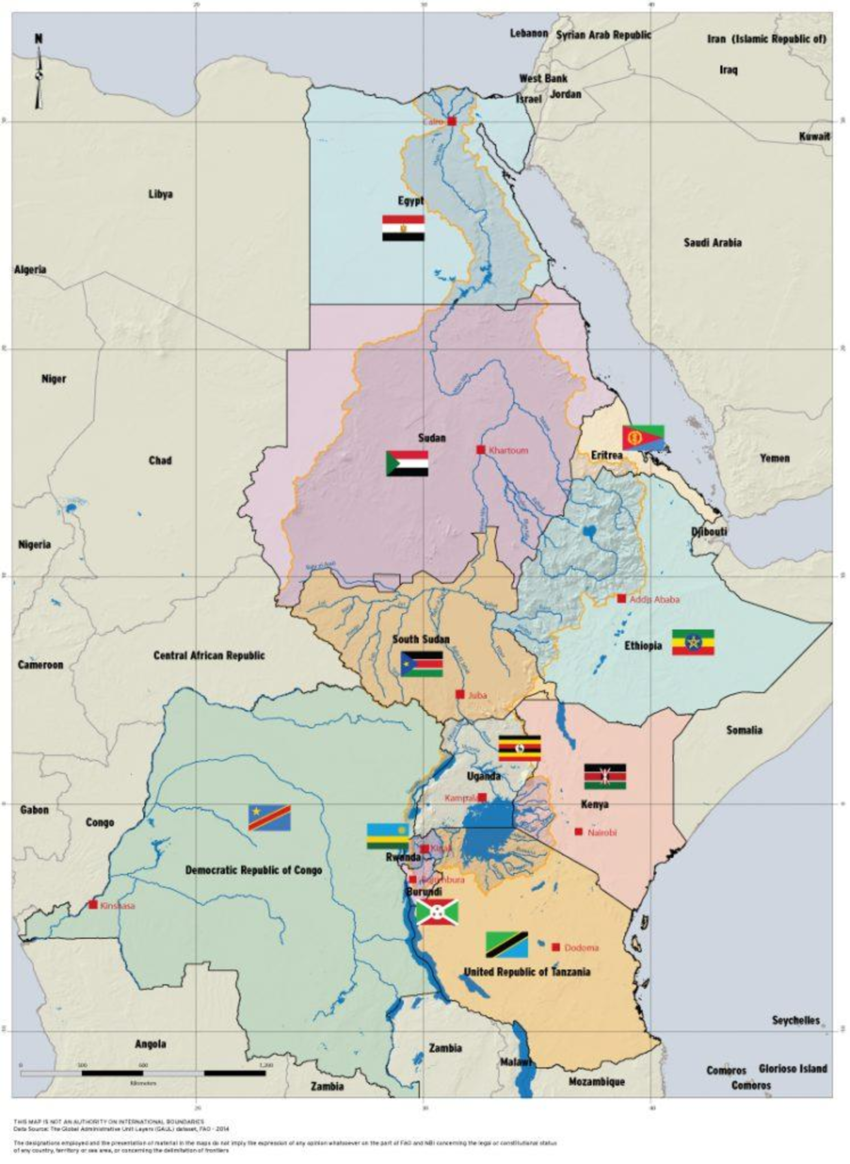
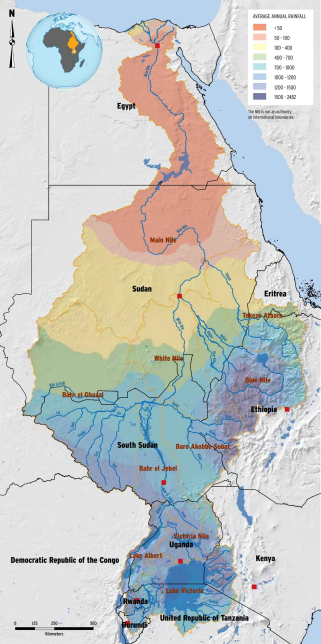
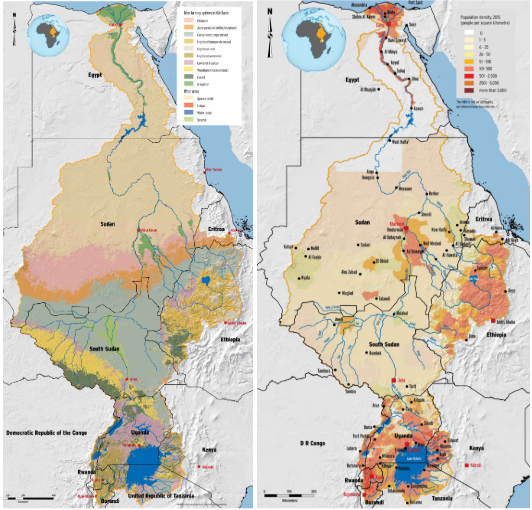
Fig. The Nile Basin countries
Egypt, which lies at the lower end of the river, experiences almost no rainfall. The country thus depends on the river to provide almost all of its fresh water. Halidu et al. (2025), based on Swain (2002), report that Egypt receives more than 90% of its fresh water from the Nile, while more than 95% of its population lives along the river Sudan, on the other hand, is both a downstream and an intermediate state that relies on the waters of the Nile mainly for irrigation. The capital, Khartoum, is the meeting point of the Blue and White Nile. Ethiopia, finally, is the main source state. The Blue Nile, which flows through and originates from the country, accounts for about 85% of the basin’s annual flow, a figure that other sources attribute more broadly to the Ethiopian highlands.
The current dispute concerns the Great Ethiopian Renaissance Dam (GERD) on the Blue Nile, construction of which began in 2011. While Egypt sees this as a threat to its water security, Ethiopia presents it as an exercise of its right to develop its own resources. However, the conflict over the GERD goes far beyond the mere construction of the dam. The problem is actually rooted in a diplomatic knot, made up of historical power relations, colonial-era agreements shaped by subsequent governments and differing views on water rights. In this way, colonialism should be understood here as an important historical foundation, to which more modern problems are added, such as population growth, economic development, hydropower, Ethiopia’s changing priorities, and the lack of a basin-wide framework agreed by all states.
2. Egypt and Sudan’s Hegemony
Control of the Nile and water security can be traced back more than 700 years. Some tell the story of a 13th-century Ethiopian emperor, AmdeTsion, who sent an envoy to Cairo to Sultan Al-Nasir Muhammad Q-Alaum to protest against the persecution of Coptic Christians.
His message was a clear warning: Stop, or the Nile might not reach you at all.
Another tale jumps ahead to 1513, the priest-king Prester John brought a Portuguese explorer, Alfonso d’Albuquerque, to see how to divert the Nile towards the Red Sea. Whether these stories are fact-proven historical events or legends told over time, they all point towards the same concept: people have long understood that whoever holds control over the Nile undoubtedly holds significant power over Egypt.
Britain’s interest in Egypt had a lot to do with the Suez Canal and the road to India, but the Nile quickly became the real prize. They colonized Egypt in 1882, then Sudan in the late 1890s, and went on to rule Uganda, Kenya and Tanganyika, which together held much of the Nile’s upstream reach.
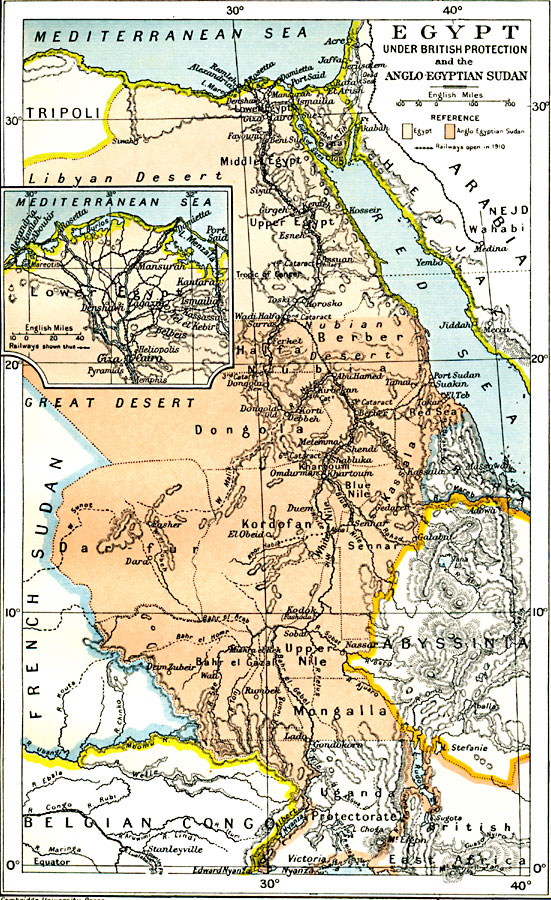
Fig.: Egypt Under British Protection and the Anglo–Egyptian Sudan (Source: Ward, Prothero, and Leathes, The Cambridge Modern History Atlas (New York, NY: The Macmillan Company, 1912)
Cotton, grown on a massive scale in Egypt to feed British textile mills, was also tied to the factories in Lancashire. The Nile became more than just a source of life; it had to be dammed, channeled and managed all year round, turning it into a commercial asset of strong strategic value. Step by step, the river would become a scarce material, something to be secured, exploited and controlled in the long term.
The system governing the Nile’s current situation developed gradually throughout the 20th century, shaped by a series of treaties drawn up by the colonial powers.
Here is a look back at some of the most important agreements.
1891 Anglo-Italian Protocol. Italy, which was expanding in the Horn of Africa at the time, agreed not to build works on the Atbara River that could affect the flow of water into the Nile. Britain wanted to protect the Nile system on which Egypt and Sudan depended.
1902 Agreement between Great Britain and Ethiopia. Britain signed on behalf of Egypt and Sudan. Under the agreement, the Ethiopian Emperor Menelik II agreed not to undertake or permit works across the Blue Nile, Lake Tana and the Sobat that could impede the flow of the Nile, unless agreed with the British authorities. Ethiopia was therefore a party to this agreement, against the common simplification according to which Ethiopia didn’t sign a treaty with a colonial power. Nevertheless, Ethiopia later rejected the agreement as unfavorable, and the agreement has been described by some commentators as “vague”, noting translation issues. Its significance, however, was clear in establishing restrictions on Ethiopia’s ability to develop water infrastructure on the main sources of the Nile.
1906 agreements. Britain concluded an agreement with the Congo, under which the Congo agreed not to build works on or near the Semliki and Isango rivers that would reduce the water entering Lake Albert without agreement from Sudan. A separate agreement among Britain, France and Italy, dated 13 December 1906, reaffirmed the 1891 and 1902 arrangements. These arrangements reflected the competing interests of the European powers in Ethiopia and the wider Nile Basin, but also Britain’s particular concern with protecting the Nile for Egypt and Sudan
1925 Anglo-Italian exchange of notes, particularly concerning Lake Tana. Britain sought to protect the hydraulic interests of Egypt and Sudan, even though Lake Tana is located in Ethiopia. Years later, the Ethiopian government appealed to the League of Nations, which ruled that Ethiopia was not legally bound by this exchange of notes. The episode nevertheless illustrates the growing conflict over whether European agreements could determine Ethiopia’s rights over the waters originating in its territory.
1929 Anglo-Egyptian exchange of notes. The United Kingdom negotiated with Egypt to assign the country 48 billion cubic metres per year; Sudan was assigned 4 billion. Egypt also received a right to object to upstream works that could harm its interests. Before this, British commissions had examined Egyptian and Sudanese irrigation needs, including whether the Sennar Dam in Sudan would affect the Lower Aswan Dam. The 1929 exchange is widely seen as the most important of the colonial agreements, because it gave Egypt veto power over upstream infrastructures and treated Egypt as a priority.
The 1959 Agreement between the Republic of Sudan and the United Arab Republic for the Full Utilization of the Nile Waters came after Sudan’s independence.
It allocated 55.5 billion cubic metres to Egypt and 18.5 billion to Sudan and allowed the construction of the Aswan High Dam. It also reaffirmed the two states’ power to accept or reject Nile projects affecting their interests. The upstream states were not parties. The 1959 agreement is not considered a colonial treaty, because it was signed by two sovereign states. It is, however, widely seen as extending the logic of 1929.
After decolonization, the main question was no longer who had signed the treaties, but what status they now had; three positions emerged. While Egypt and Sudan stress historical and acquired rights, referring to the 1929 and 1959 agreements, upstream states stress sovereignty over resources within their territories, and many treat the 1929 agreement as non-binding because it was concluded by colonial powers. A third position is that a river shared by many states should be governed by equitable and reasonable use, with, hence, the obligation not to cause significant harm to other riparian states.
The distinction between treaties and their later interpretation is therefore important. Not every colonial treaty is legally valid today, and several were contested early on. Even so, postcolonial governments chose to interpret and defend them in different ways. The result is not a single legal order but a set of disputed arguments, and the dispute is part of the foundation of the contemporary conflict.
3. Thoughts on Colonialism
Many authors present colonial rule as the origin of the unequal Nile order. Under colonial rule, the river’s use was regulated by treaties that created obligations and water rights for the colonial territories. On one hand, these arrangements favoured Egypt, Sudan, and Britain’s position. On the other hand, the treaties deeply weakened Ethiopia’s claim to its own water. According to Halidu et al. (2025), From Colonial Agreements to Contemporary Conflict, as we will see, colonialism gave it a legal and institutional form, in conjunction with several elements.
First, the 1929 Anglo-Egyptian agreement and the 1959 Egypt–Sudan Treaty were drawn up without the states where the Nile’s waters originate. The treaties were “negotiated in colonial or post-colonial settings, inclusive or exclusive of most of the upstream riparian states”. Moreover, it gave Egypt “veto power on upstream development that would affect its water security”. Egypt was able to claim a right to approve or block projects on rivers that flow through other sovereign states, which in practice constrained Ethiopia’s ability to develop projects on the Nile without Egyptian opposition. Second, the 1929 treaty gave Egypt 48 billion cubic metres (bcm) per year and Sudan 4 bcm. The 1959 treaty raised these shares to 55.5 bcm for Egypt and 18.5 bcm for Sudan, though 85% of the Nile’s annual flow reaching Aswan originates in Ethiopia’s highlands, mainly through the Blue Nile, but also through the Atbara and Sobat rivers.
Third, the treaties turned Egypt’s colonial-era advantage into lasting dominance. Egypt became the “colonial beneficiary” of these arrangements, which gave Egypt a legal and discursive basis for presenting the existing allocation as natural and legitimate. Additionally, Egypt’s claim has hardened into a security doctrine.
Fourth, the colonial treaties are incompatible with contemporary norms, particularly the principle of “equitable and reasonable utilization” in the 1997 UN Watercourses Convention. Due to the “rigidity of colonial agreements in response to present realities”, from Ethiopia’s perspective, Egypt’s emphasis on the principle of ‘no significant harm’ can be used to preserve the existing allocation, even as Ethiopia invokes the principle of equitable and reasonable utilization. This legacy also blocks the creation of a replacement regime, like the Cooperative Framework Agreement (CFA), signed in 2010 by several upstream states to correct the failures of the colonial system.
After decolonization, the political actors changed, but the legal framework did not. Newly independent upstream states questioned why agreements negotiated by Britain should determine their rights over water within their own territories. Meanwhile, Egypt moved quickly to protect the status quo. Postcolonial multilateral attempts at cooperation, such as the Hydromet survey from 1967 to 1993, Undugu from 1983 to 1993 and TECCONILE from 1993 to 1999, did not produce a basin-wide agreement. Colonialism is therefore best understood as having produced an institutional framework and a set of unresolved claims.
4. Ethiopia’s Initiatives and the GERD
Ethiopia’s policy became more assertive from the late twentieth century as they came with the 1993 Framework for General Cooperation with Egypt. Signed in Cairo, it was only the second Nile-related agreement signed by Ethiopia since 1902. Both states agreed not to take action that could harm the other’s interests in using the Nile. Its terms were disputed, particularly about what counted as “substantial damage”, and the two sides read it differently: Egypt saw it as preserving the status quo, and Ethiopia continued to reject the 1902 agreement.
The turning point of the Nile Basin Initiative (NBI) in 1999 tried to replace TECCONILE and, for the first time, aimed to include all riparian states. The objective, backed by the World Bank and other donors, was socio-economic development through equitable utilization of the water. One of its main products was the Cooperative Framework Agreement (CFA), which was signed in 2010 by Burundi, Ethiopia, Kenya, Rwanda, Tanzania and Uganda. It reaffirmed equitable and reasonable use and provided for a permanent Nile River Basin Commission. Egypt and Sudan refused to sign, in particular because of disagreement about how to define “water security” and whether existing uses and rights should be protected.
The GERD is perhaps the most important affirmation of Ethiopian rights in recent years. Located on the Blue Nile at the Sudanese border, the government announced its construction in 2011, although it seemed to have thought about it for several years. Its initiation in 2011 was based on increasing power needs and food security and caused “considerable consternation in Cairo and Khartoum”.
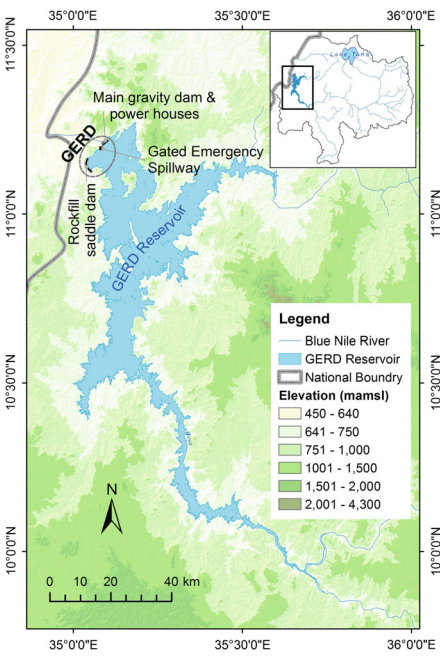
Fig. : The Grand Ethiopian Renaissance Dam at the Ethio-Sudan border (Source: Abtew and Dessu, p. 32)
The expected capacity is over 6,450 megawatts, which would make it the largest hydroelectric plant in Africa, with a reservoir of 74 billion cubic meters. Part of the Blue Nile was even diverted in 2013 for its construction. The central question is to know how fast the reservoir fills and how the dam works, whether it affects the water quantity of downstream countries. Ethiopia began filling the reservoir in July 2020, with further refills in 2021, 2022, and 2023, without binding agreements with Egypt and Sudan.
Three perspectives on the GERD
For Ethiopia, the GERD offers development and exercise of sovereignty to a country whose population suffers from a lack of electricity. The Ethiopian government rejects the application of treaties to which it was not a party, invoking equitable and reasonable utilization, and describes the dam as part of a broader pan-African argument for a development path free from colonial-era constraints. It also resisted the restrictive limits on filling and operation, preferring non-binding guidelines.
Egypt’s primary concern is the possible reduction of the flow, as the country relies on a level that has remained unchanged for decades. This dependence is extreme: the Nile provides 97% of Egypt’s available fresh water, the country receives only about 80 mm of rain a year and only 6% of its land is arable.
Against this background, the filling of the dam’s reservoir, estimated at close to 74 billion m³ over 5 to 15 years, is predicted to reduce the supply reaching Egypt by 25%. This would worsen an existing deficit of 13.5 billion m³ per year, in a context of 2% annual population growth and rising sea levels that threaten the Nile Delta. Egyptian leaders have therefore repeatedly described the Nile as a security issue. For instance, in 1979, Sadat indicated that “if anyone, at any moment, thinks of depriving us of our life we shall never hesitate to go to war”. Later, Morsi called for choosing between “water and blood” in the 2010s. Ex-Egypt’s Minister of Water Resources and Irrigation, Mohamed Abdelatty, likewise labeled the threat to Egypt’s main water source “an international security issue”.
Egypt also highlights the possible – disastrous – economic and social consequences of the dam, particularly for its agriculture, which contributes 14.5% of GDP and provides many jobs. Abdelatty warned that a decline of just 2% in the flow would cost Egypt around 200,000 acres of arable land, which currently feed 200,000 families and employ about one million people.
The dam could also reduce power generation at the Aswan High Dam by 20-40%, degrade groundwater quality, and cause a sediment buildup that reduces natural alluvium fertilizing the delta. Not to mention the technical risks, which Egypt also highlights, rising unemployment and food prices could in turn recreate conditions similar to 2011. For all these reasons, the country invokes “historical rights” and the principle of non-prejudice, and criticizes Ethiopia for its “reluctancy to engage in diplomacy” and for building the dam without considering the concerns of other states in the basin. With Sudan, Egypt has sought a “legally binding agreement on operating the dam”, while seeking support from the Arab League, the African Union, and the UN Security Council.
Sudan’s position is more ambivalent, as it could benefit from the dam through flood control and potentially cheaper electricity. The country is mainly concerned about the safety of the dam and the coordination of its own operations. For these reasons, and given the country’s internal instability, Sudan oscillated between opposition and cooperation, eventually joining Egypt in demanding a binding agreement.
5. Conclusion: what about now?
Despite numerous attempts to reach an agreement, in 2026, the GERD is no longer a project under construction but an operational fact.
The dam was completed in August 2024 and was officially inaugurated on September 9, 2025, with a capacity of approximately 5,150 MW. Ethiopia broke out of the constraints of colonial-era treaties and forced downstream states to engage, “however reluctantly,” in this new framework. Politically, however, the dispute remains unresolved and negotiations remain stalled. Indeed, diplomacy has failed to reconcile Egypt’s rights and Ethiopia’s demands. UN Security Council addressed the issue, but produced only a non-binding presidential statement in 2021, which was returned to African Union leaders.
Thus, as Tafon notes, the controversy “is less motivated by hydrology than by politics and history”. While a recent study suggests that the dam can operate near its optimum without downstream deficits, Egypt seems to have no choice but to recall the importance of this existential resource after such a forceful passage. Overall, even if the GERD offers “both opportunities to redefine water arrangements in colonial times and limits imposed by enduring geopolitical mistrust”, the main obstacle to a sustainable settlement seems to be political trust rather than water supply.
References
Abtew, W., & Dessu, S. B. (2019). The Grand Ethiopian Renaissance Dam on the Blue Nile. Springer.
Alemayehu, A. (2024). Conflicts and treaty over the Nile Basin: A critical review. East African Journal of Environment and Natural Resources, 7(1), 1–16. https://doi.org/10.37284/eajenr.7.1.1673
International Crisis Group. (2019). Bridging the gap in the Nile waters dispute (Africa Report No. 271).
Halidu, A., Joy, N. I., & Onochie, O. S. (2025). From colonial agreements to contemporary conflict: The Nile Waters treaties and the Egypt-Ethiopia GERD crisis. British Journal of Interdisciplinary Research, 2(7), 1–23. https://doi.org/10.31039/bjir.v2i7.53
Khayry, F. (2022). The Grand Ethiopian Renaissance Dam and Egypt’s water security. The Undergraduate Research Journal, 8, Article 2. The Grand Ethiopian Renaissance Dam and Egyptâ•Žs Water Security
Pinfari, M. (2010). Time to Agree: The EU and the Nile Basin Initiative. European University Institute Mediterranean Programme, 11, 1–24.
Tafon, R. (2026). Hydropower after empire: How the Grand Ethiopian Renaissance Dam confronts colonial Nile legacies, and the politics of development finance. Energy Research & Social Science.